
Evidence
“The garden has become a focus not just for the school but the whole community and enabling intergenerational community space to be a be real joy outside school hours. The Go Flourish project has shown real opportunity to change lives for the better”.
Councillor Lyndsey Johnston
The Problem
The Scottish Government recognises social isolation and loneliness as a public health issue. Its strategy, A Connected Scotland, and its delivery plan, Recovering our Connections 2023 to 2026, aim to create opportunities for people to connect and to support places that foster connection. Yet only 56% of adults in Scotland agree there are welcoming places and opportunities to meet new people in their neighbourhood, and the share of adults meeting socially at least once a week fell to 65% in 2025 (Scottish Household Survey). Loneliness is most common among the youngest and oldest adults, the very generations a school garden brings together.

Rural communities face particular challenges. As Councillor Sarah Atkin writes in her letter of support, families on the Black Isle face huge isolation challenges that are often overlooked, sitting between the urban and the remote. A school was once the heart of its community; a garden shared by school and community can help it become so again. Nature and nature spaces are also cited in the Black Isle Place Plan as something the community values.

At the same time, people are losing everyday contact with nature, what the Highlands and Islands Climate Hub calls an "extinction of experience". When we started at North Kessock, no child in our nursery baseline named a fruit or vegetable as a favourite food, and none of seven had heard of a courgette.
Loneliness and disconnection
'Education systems should introduce Nature studies from the earliest stages of our lives and revisit them in the years we spend in secondary and tertiary education'. (The Dasgupta Review: The Economics of Biodiversity)

Many communities have lost the everyday places and routines that once brought people together and now rely on government intervention rather than on one another. Government has its own responsibilities but increasingly finds that it must step into areas that were once the domain of families and communities. For example, in autumn 2025 schools introduced a personal care package because a significant number of children still arrive at school in nappies. A school was once the epicentre of its community; a garden shared by school and community can help restore that connection.

We rely on nature for all our physical needs, yet year on year our connection with the natural world, and our understanding of how it works, diminishes. Around the world, agricultural land is in decline because of mechanical and chemical farming methods. Future generations will need a good understanding of the holistic interconnectedness of the natural world, and the practical skills to grow their own food.

'Without a healthy environment, there are no shareholders, no employees, no customers, and no business.' Yvon Chouinard, Founder of Patagonia

AI is altering job opportunities. Many white-collar jobs will be lost, and new career paths need to open up. As the need to change the way we grow food becomes ever more urgent, the loss of these jobs coincides with the need for more skilled people on the land. At present, schools offer little opportunity to learn these skills. The Go Flourish model will open up new career opportunities.

"Go Flourish contributes to national climate action and biodiversity targets by embedding climate education and practical horticultural skills in young people. In doing so, it helps nurture a climate-resilient generation capable of leading the shift toward localised food production and sustainable living."
Aisling Phillips, Inner Moray Firth Community Development Officer, Highlands and Islands Climate Hub
Why it matters
Over the last decade, mental health issues among Scottish pupils have increased by 580%. Today, 1 in 6 children (aged 8-16) have experienced mental health problems in the past year, including anxiety and depression, and children in households under financial strain are twice as likely to experience poor mental health.

While there are many causes behind this growing crisis, we believe that disconnection from nature and from practical, outdoor activity is a major contributing factor. A 2019 Danish study found that children who experienced the lowest level of green space were 55% more likely to develop a psychiatric disorder.

Meanwhile, according to the EIS Teaching Union, our education system has a deficit of over 4,310 teachers and the remaining workforce struggles to manage disruptive behaviour, serious incidents and general disengagement. There is evidence from the University of the West of Scotland that 1 in 8 newly qualified teachers in Scotland leaves the profession or the country, and cumulative data shows over 2,081 teachers quit within five years of entry between 2018 and 2025.

In Scotland, every secondary school is mandated to have access to a registered professional counsellor to support children with emotional and behavioural difficulties, however access is inconsistent and varies by area. There is currently no mandated provision in primary schools in Scotland.

With school budgets already stretched thin, the growing need for extra support to address mental health issues places further strain on teachers and resources. The long-term impact of this trend is undeniable: lives unfulfilled, potential unrealised and greater strain on the NHS as a consequence of depression, and on the economy through lost work days.

In response, Education Scotland and the Scottish Government have launched a National Action Plan (2024-2027) which focuses on trauma-informed, nurture-based approaches to rebuild children's readiness to learn.
Children's mental health
Children appear to struggle more and more with self-regulation, resilience and classroom concentration. A study of more than 20,000 primary aged children by Nottingham Trent University found a reduction in resilience, motivation, self-efficacy and positivity since the pandemic. The BISSR (Behaviour in Scottish Schools Report) found that, as a consequence of their disrupted transition during Covid, children have delayed social and communication skills, which show up as emotional dysregulation in the classroom.

The BISSR also refers to compounding issues of social media, reduced face-to-face interaction, limited physical activity, and excessive screen time, all of which contribute to the growing problem.

"Parents and children today so often live parallel lives. Screens have replaced conversation which, in turn, fuels loneliness and mental health challenges."
Councillor Sarah Atkin, Black Isle
Children and screens
Our Evidence-based Solution
We believe that gardens shared by communities and their schools offer a powerful, nature-based answer to these challenges. Outside school hours, they give people of all ages a welcoming place to meet, belong and reconnect with nature. During the school day, they are vibrant, hands-on learning environments where children reconnect with nature and learn essential life skills. Our gardens provide space for children to build resilience, focus and creativity, and give them the tools to thrive both inside and outside the classroom.

Fundamentally, when lessons take place in a natural environment, both children and teachers feel less stressed, and lessons become more enjoyable and engaging. Studies show exposure to nature strengthens resilience against stress and depression, with the greatest benefits for vulnerable children.

We have evolved to use all our senses to interpret the world around us. However, our education system doesn't account for this, and successive generations are now disconnected from the world that nurtures us. Within their garden, children can find quiet corners filled with scented plants, grow vegetables and fruit, and explore magnificent play structures where their imagination can take flight.
Why gardens
Under the Community Empowerment (Scotland) Act 2015, every local authority in Scotland must prepare and publish a local food growing strategy to identify land for allotments and community gardens, support local growers and expand provision, particularly in areas facing socio-economic disadvantage. The expected benefits are improved health and wellbeing through improved diet, reduced food miles, enhanced local biodiversity and improved climate resilience.

The Highland Community Planning Partnership (HCPP) implements the Act through the Highland Outcome Improvement Plan (HOIP 2024-2027). Key themes include Connecting People and Places; Whole Families and Community Based Approaches; Employment and Employability; Community Wealth Building; Housing; shared Approaches to Commissioning; and Aligning Partnership Practices. Our community gardens meet a number of these themes, most directly Connecting People and Places and Whole Families and Community Based Approaches.

We are aligned with the Scottish Government's Target 2030 Learning for Sustainability Action Plan:

- Closing the attainment gap
- Climate literacy
- Teacher retention
- Preventative mental health

Our work also contributes to the UN Sustainable Development Goals, in particular Goal 3 (Good health and well-being), Goal 4 (Quality education), Goal 11 (Sustainable cities and communities), Goal 12 (Responsible consumption and production), Goal 13 (Climate action) and Goal 15 (Life on land).
Go Flourish is also recognised as a Green Health initiative by the NHS: “The Go Flourish project provides a strong example of how local, community-led initiatives can contribute to the wider prevention agenda."
Strategic fit
Garden design has a strong psychological element. Before we were agriculturists, and for a long time after, we were both predators and prey. The landscape we felt safest in was a savannah type landscape, open but studded with trees and shrubs: somewhere we could see without being seen. This remains embedded within us.

We feel anxiety in a tight, narrow space and relief when we walk into a more open one. Round shapes make us feel calm, repetition soothes us, and water is always relaxing. Meandering paths can slow people down, and 'swells' and 'constrictions' in a path can encourage people to linger or to speed up.

So the question we ask of every area of a Go Flourish garden is: how do you want people to feel here? Once that choice is made, every decision supports the atmosphere we want to create.
Designing for how people feel
Go Flourish and the University of St Andrews are working in partnership to investigate the impact of a school gardening project on children's mental health and wellbeing. Our partnership began in early 2024 with a three-year longitudinal study that compares a primary school in Ross-shire with a local control school matched for geographical location and demographics.

The study uses a mixed methods approach, with a range of quantitative and qualitative assessments. Information is collected from parents, children and teachers at three points in the school year, so the picture is balanced and in depth. Parents complete two questionnaires about their child's wellbeing, children complete a moods questionnaire and a questionnaire on their relationship with nature, and teachers are interviewed about the programme and about time spent in nature.

We track changes in attention (ADHD), emotional regulation, stress, and literacy and numeracy.

Our research partners at the University of St Andrews also work with a university in the Netherlands.
How we test it
Beneficiaries & Financial Effectiveness
Our beneficiaries are the whole community within each school's catchment area and the wider area.

Direct beneficiaries: the community, including families, grandparents, older people, volunteers, people on the road back to work, local groups and businesses, and everyone who uses the garden outside school hours; and the children who learn in the garden during the school day, who in turn bring their families into the garden.

Indirect beneficiaries: local businesses. Relationships between communities and local businesses improve because everyone has pulled together to make these gardens happen.

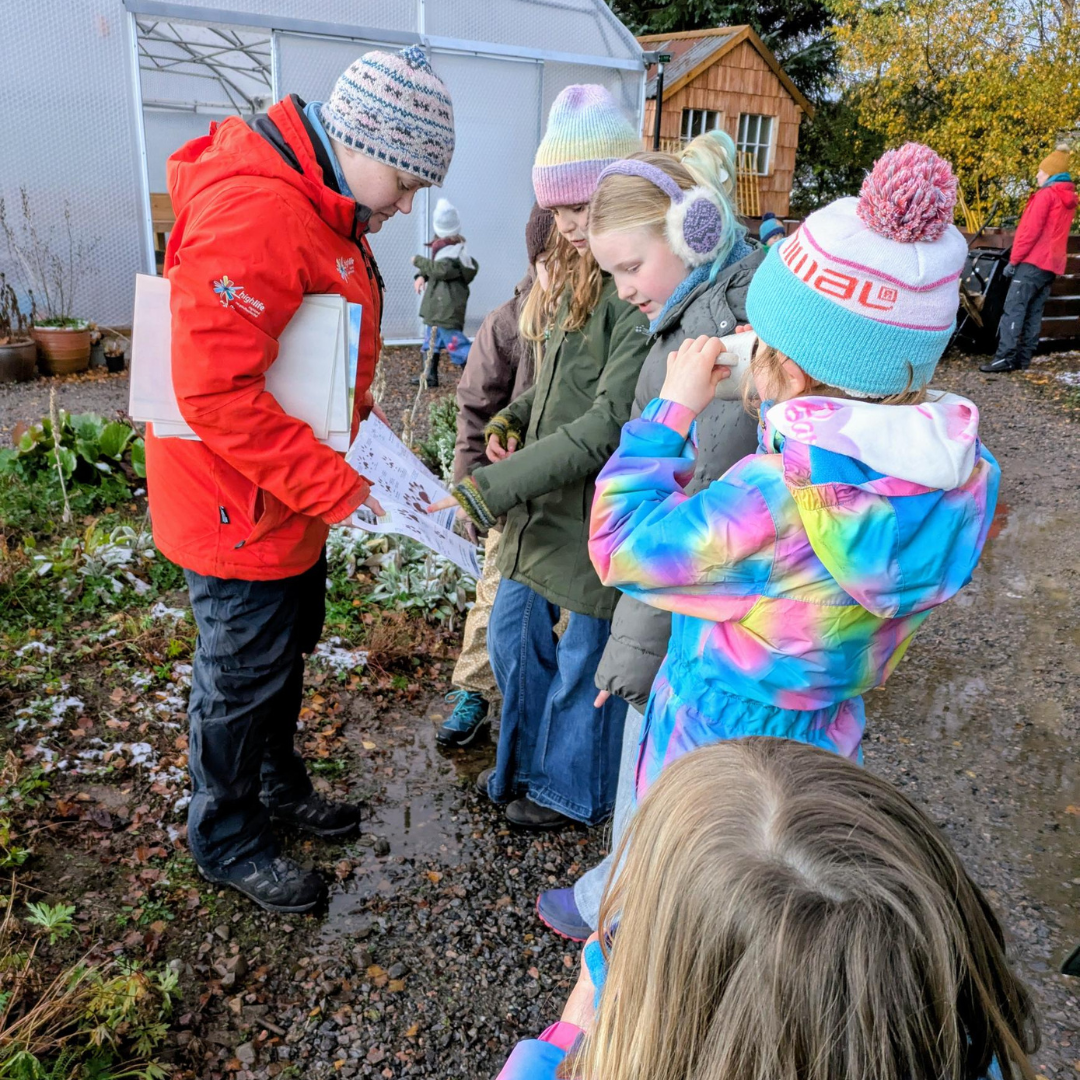
We see this every week. At our community gardening sessions, Eco Warriors have brought along a little sister and a granddad. As one volunteer put it, "it's the children bringing their adults." A P7 boy from Munlochy and his dad now garden at North Kessock together every week, and he is building a mini Go Flourish garden at home.

"They come out excited and keen to share their stories and show us what they have grown. They love their time in the garden and encourage me to come and volunteer in the garden in school holidays."
Grainne McCann, community volunteer and parent, North Kessock Primary School
Who benefits
3 years delivering a community garden at North Kessock155 people reached directly and 2,131 indirectly (426 and 5,860 once the Dalneigh garden opens)99 children and families taking part in the University of St Andrews study since August 202420+ schools have contacted us to ask about a Go Flourish garden14 organisations wrote letters of support for the Dalneigh garden60+ people signed up to our Growing Food in Schools event with the Highland Good Food Partnership (February 2025)£1052 raised for Go Flourish by the school children at North Kessock
By the numbers
Loneliness and isolation: the garden brings people of all ages together, so neighbours become more aware of each other's needs and value each other's skills. People who may have felt invisible find their place.
Connection between generations: grandparents, parents and children garden side by side, and pass on skills and knowledge to one another.
Creativity: people can be creative at every stage, from the first design of the garden to its everyday use and development.
Nutrition: children and adults learn how to grow vegetables, which builds an understanding of nutrition and helps people make better-informed choices about the food they buy.
Connection to nature: we want to develop a sense of wonder and awe at the beauty of nature, and a desire to protect it, which will shape the choices people make.
Community connection: as high streets decline and local meeting places disappear, the garden gives people of all ages a place to meet at weekends, in the evenings and during the school holidays.
Teacher stress: outdoor lessons benefit staff as well as children. Staff at North Kessock say their time outside has a positive effect on both them and the children.
Additional support needs (ASN): Scotland spends £926 million a year on ASN. Children who struggle in the classroom, especially those with ASN, are often calmer and more confident outside.
National food resilience: children who learn to grow food gain practical skills for a future in which local food production will matter more.
Climate awareness and action: our gardens embed climate education and practical horticultural skills in young people.

"Some children struggle within the classroom setting, especially those with ASN. One of our strategies is to take them outside. We have noticed the benefits of this: children are calmer, more willing to chat and show increased confidence."
Andrea Millar, Acting Head Teacher, North Kessock Primary School
The needs our gardens meet
Each garden is designed and built using community assets: skills, materials, finance, businesses and contacts. The community leads the fundraising for its garden, and Go Flourish signposts suitable grants. Our first garden, at North Kessock, was gifted because we needed proof of concept; the model going forward is that each community builds its own.

Our accounts are independently verified each year, and we have recently moved to the Xero finance platform. Our finance trustee, Christopher Akers, helps steer finances and oversee projections, and a dedicated bookkeeper keeps them on track. We hold a target of six months' reserves, which was met in the year to 31 August 2025.